

My Story
This page is my jotter for stories from my past. my Writers Notebook. Two terms loaded with emotional torpex for me. I started out writing down how I came to be an artist. A watercolourist. And then I learnt, from Lennon Bone that stories are the gold for Social Media. Therefore here they are. One day if God spares me I will order them chronologically. .
1. Early family years
I began life thinking I would be a scientist.
I grew up in a family of artists. My parents were both world-class musicians and my siblings went to high schools focussed on developing artists. At a very early age my grandmother sat me on her knee and told me that I would be the scientist of the family. I took on this ill-fitting mantle – though of course at the time I had no clue.
My folks once gave me a rather arbitrary book on Marine Science that I convinced myself would be the direction to follow. And so I joined the Department of Sea Fisheries after school, taking a break for military service before working in Walvis Bay. I then returned to Cape Town to study for my career
Therefore a month out of school I found myself playing bar-dice for drinks next to the local cop who was totally scribbled in a bar in Lüderitz. I was on a trip to tag seal-pups to gain a reasonable count of the seal stocks.
iIn my last couple of years at school my long-suffering mother used to load four of us kids in here VW stationwagon and we would drive from Honeydew down to Simonstown in the Cape, where we would stay in a cottage in The Green Lantern near Boulders Beach. After years of holidaying in Durban it was wonderful to see pristine white sand, mountains across the bay and South Easter. When I had finished my Matric year we took the same trip and my dad joined us.. A school friend of mine from Pretoria had relocated to Fishoek just around the bay from Simonstown and I went to visit him, His brother, Tom, was a diver with the Department of Sea Fisheries and he told us they were employing Laboratory Staff. I drove in to the offices in Seapoint with my dad and spoke with the hed of the department and took a Lab-assistant job.
So when my family headed back to what was then Transvaal I stayed with Chris and his parents. Each morning his dad and I would catch the 06:00 train to Cape Town and would catch a bus to Seapoint. It was a great introduction to working life.
after a month or so I jioned a team who went up to luderitzz to tag seal pups in the two large rookeries on the coast there. These days we would fly, but in those days we took a four day train trip. I remember being stuck in Keetmanshoop while they cleared sand off the tracks to Luderitz. So I found myself at 17 playing 21s for drinks in a bar in Luderitz. The one who threw the 7th Ace ordered a drink. The one who threw the 14th paid for it. And the one who threw 21 drank it.
And for two days we worked in the two rookeries rounding up pups and clipping numbered stainless steel tags where their flipper joined their body. We would record the sex of the pup and move on.
We then waited a week then went into each rookery again and rounded up groupls of pups and counted tagged vs untagged from which we could calculate the population of pups. The leader of the team was an Australian - O'Shaunessy was his name. Head of Marine Mammals. I rememember he was dissapointed that I could not cut of the heads of some of the dead bulls lying there, The bulls apparently fight to the death for real-estate and females. Their hide was too tough for sea birds and so they lay there fermenting for months. My tender stomach could not handle the smell.
Then we took a train back to cape town.
This seemed like a good start so I signed up for the Technical Assistant programme. They game me leave to do National Service and after 8 months of work I went up for my stint.
On return to Cape Town after service I went in to the offices in Seapoint but within a week they had reposted me to Walvis Bay. So like Rudy, I was back on the train.
A
Leaving Swakopmund
When worked in Walvis Bay [walvis by story] I received a letter from my mother who – amongst other things said “Steve – you must go to University”. She did not know but I had kind of resolved to do the Technicians programme for The Department of Sea Fisheries really because that was where I worked and that was what I supposed one did. This was all part of my aimless drift through life.
And so I went to Bob Rand [who wore a seal skin to observes seals on the Pribilof Islands] the head of the department in the lab in Walvis Bay. I put the idea to him and filled in the forms my mother had sent me. Bod said he would give me study leave to go to university to study Marine Science. It was all quite loose and informal. Though it was leave. The proviso that I forgot was that I was to come in and work for the department in my holidays. A few weeks later I received a card in the mail that The University of Cape Town had received my application. And on the strength of that, a week and a few days before the term began, I packed my rucsac and walked through the town to road to Windhoek. I remember being greeted by two of my friends as I stood on the road, And they took a photo of me in my hiking stance.
And that was goodbye to Swakopmund.
I was picked up by someone I knew. A corporal who was particularly fearsome in the Military Base Walvis bay where I had spent some time in my military service. And I remember how pleasant it was chatting with him. Who knew? But this was a real insight for me. I can’t recall much of that journey except being dropped at Grunau by someone who had turned East on his way to Johannesburg. There I met another young guy on his way to sTellenbosch. He had been there for a few hours. And as we stood I went across the road to look at the road sign for the T Junction. On the back of the sign someone had scratched “I have been waiting here for a whole day”. Then “Two days in this hell”. Then “three days”! It was rather unnerving. But as the sun was going down we were picked by a truck heading for Cape Town. Someone transporting furniture. So we each found a comfy chair and chatted through the night. Early in the morning the driver dropped me off on a turnoff to the industrial area near Pinelands. I walked a few kilometres to the house of an old girlfriend of mine who I had met durning military service [the sports trip]. We had connected briefly before the Sea Fisheries had put me on the train up to Walvis Bay.
Later that day I found my way to Fishhoek where I had lodged for eight months before catching the train to JHB to report for military service. I had a nght there I think then my friend Chris dropped me off at a residence at the university. Apparently my application had been successful.
This intent shifted when I signed up for a degree in in Geology and Chemistry. How did that happen
Some years later, with a BSc in Geology and a Masters in Materials Science I went to work at Rössing Uranium Mine in Namibia. A year later I joined the team writing code for the new computer systems on the mine.
I took classes with the artist and began my journey in watercolour. This is when I first felt the urge to become an artist. But after studying for so long, getting married and starting a career in systems design – well the shift was too big to contemplate.
And I kept painting watercolours. In 2016 I started painting one watercolour day as a marketing exercise. Each day I would post my work on Instagram.
And then the world stopped. The global house-arrest shorted-out any possibility of continuing to facilitate workshops. Ja, there were tools. But nothing like kneeling at a table, listening to the discussion and suggesting what could improve the outcome. Nothing tactile. Nothing personal.
And so as two weeks to flatten the curve turned into three months, with no end in sight, I laid a plan before God, contracted with Aura and sat down to paint watercolours.
And, of course, here I am with you on Social Media.
Some years later, with a BSc in Geology and a Masters in Materials Science I went to work at Rössing Uranium Mine in Namibia. A year later I joined the team writing code for the new computer systems on the mine.
I took classes with the artist and began my journey in watercolour. This is when I first felt the urge to become an artist. But after studying for so long, getting married and starting a career in systems design – well the shift was too big to contemplate.
And I kept painting watercolours. In 2016 I started painting one watercolour day as a marketing exercise. Each day I would post my work on Instagram.
And then the world stopped. The global house-arrest shorted-out any possibility of continuing to facilitate workshops. Ja, there were tools. But nothing like kneeling at a table, listening to the discussion and suggesting what could improve the outcome. Nothing tactile. Nothing personal.
And so as two weeks to flatten the curve turned into three months, with no end in sight, I laid a plan before God, contracted with Aura and sat down to paint watercolours.
And, of course, here I am with you on Social Media.

The Start
I have begun to build a name as a watercolourist and this year is the next phase in the growth. This will require me to be more fanatical about preserving and using my time wisely – therefore the work I am putting into my plan is key – execution will also be critically important.
And an important component of all this is my life trajectory, the key events and what I want in my future.
A BSc in Geology and Chemistry, a Masters in Applied Science set up 15 years in corporate followed by 25 years in consulting. I learnt to find elegant solutions to business issues by creatively applying academic learning. As one may expect from any artist worth his salt. But I am getting ahead of the tale here. Back to the story.
When I left school I joined the Dept of Sea Fisheries in Cape Town, a government organisation set up to monitor the fishing industry in all of it’s forms around the coast of South Africa and what was then South West Africa.
After the obligatory term in the South African military I returned to the Sea Fisheries and was put on a train to join the team in Walvis Bay, then the working port for the West Coast pelagic fish Industry. I could write a book about this interlude where I met some very interesting characters and was first introduced to the quaint little town of Swakopmund.
I used to go through in the evenings after work to train in the Olympic sized pool in the town. After a while I found digs in the town with a lift to Walvis each morning.
The head of the local office was a guy called Bob, a marine mammal scientist who had studied seals on the Pribilof Islands by wearing a seal-skin and hanging out in the rookeries. Anyway Bob signed off on study leave for me to study Oceanography and Marine Science at UCT. On the strength of a card I received that the university had received my application I packed rucsac and hitchhiked down to Cape Town.
My parents had done some admin behind the scenes and I checked into a residence and got into the serious business of preparing to study.
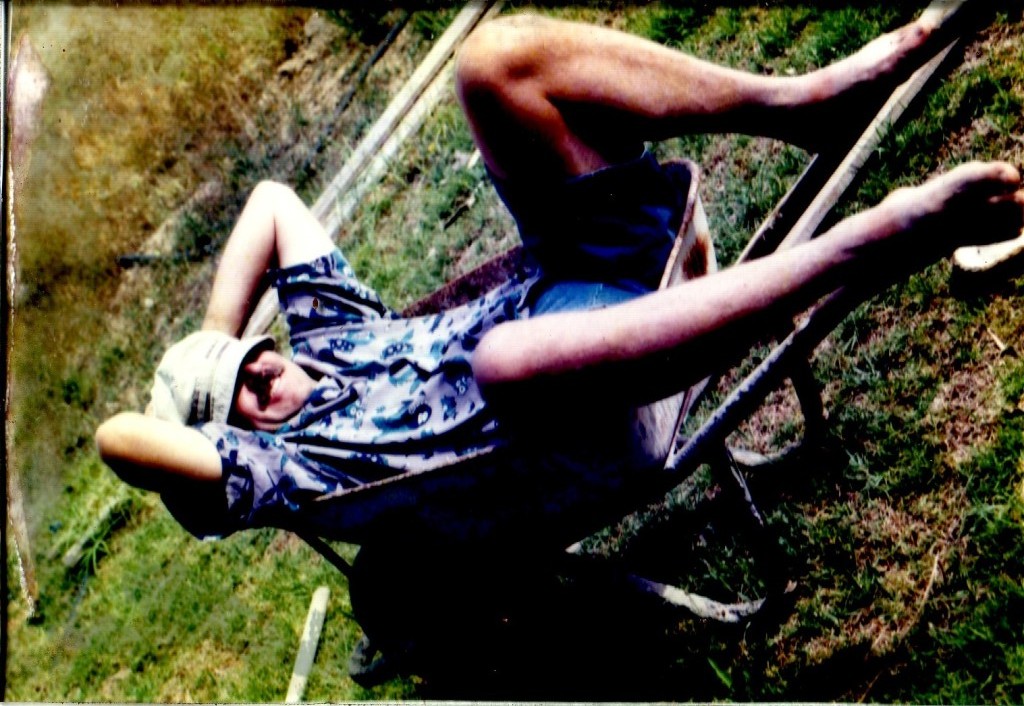
Starting out at University
I was resolved to get my head down to study hard.
Then I encountered a thing called “Freshers Week” where new students had a series of events to meet each other and the university and they had a four days to sign up for their courses. It was a lot of fun. I remember at breakfast on Thursday morning someone asked me if I had signed up for all my courses. I said I would do that tomorrow. But I was told, today was the last day for first years. So I headed up to campus.
On the way up I met some of my new friends coming down. They said they were planning to go to Muizenberg on the train at 10:00 and that I should join them if I was finished. I remember signing up for all the BSc courses required. Then I needed to sign up for a my Major Course. I stood at the back of this long queue for the Zoology I required for Marine Science. Each person took a long time with the Prof behind the desk. I looked at my watch. I was not going to make the 10:00 deadline. I looked around. I saw a queue to sign up for Earth Sciences. There were four people in the queue. I went over and signed up for my career in life.
I have never written this story down and have not told it for decades. But now as I write I feel a deep churning of shame and regret and sadness. How could it be that I was so rudderless? Why had it not occured to me why I was so different from the engineers, doctors and accountants? I shared a room with a very pleasant fellow who was studying Busienss Science, who later went on to become head of the The Bank of America in Canada. Why had I never stopped to think about life and how I was supposed tp live it?
Finishing my BSc
First year sharing a room with Kev
Wild coast hike - end 1978
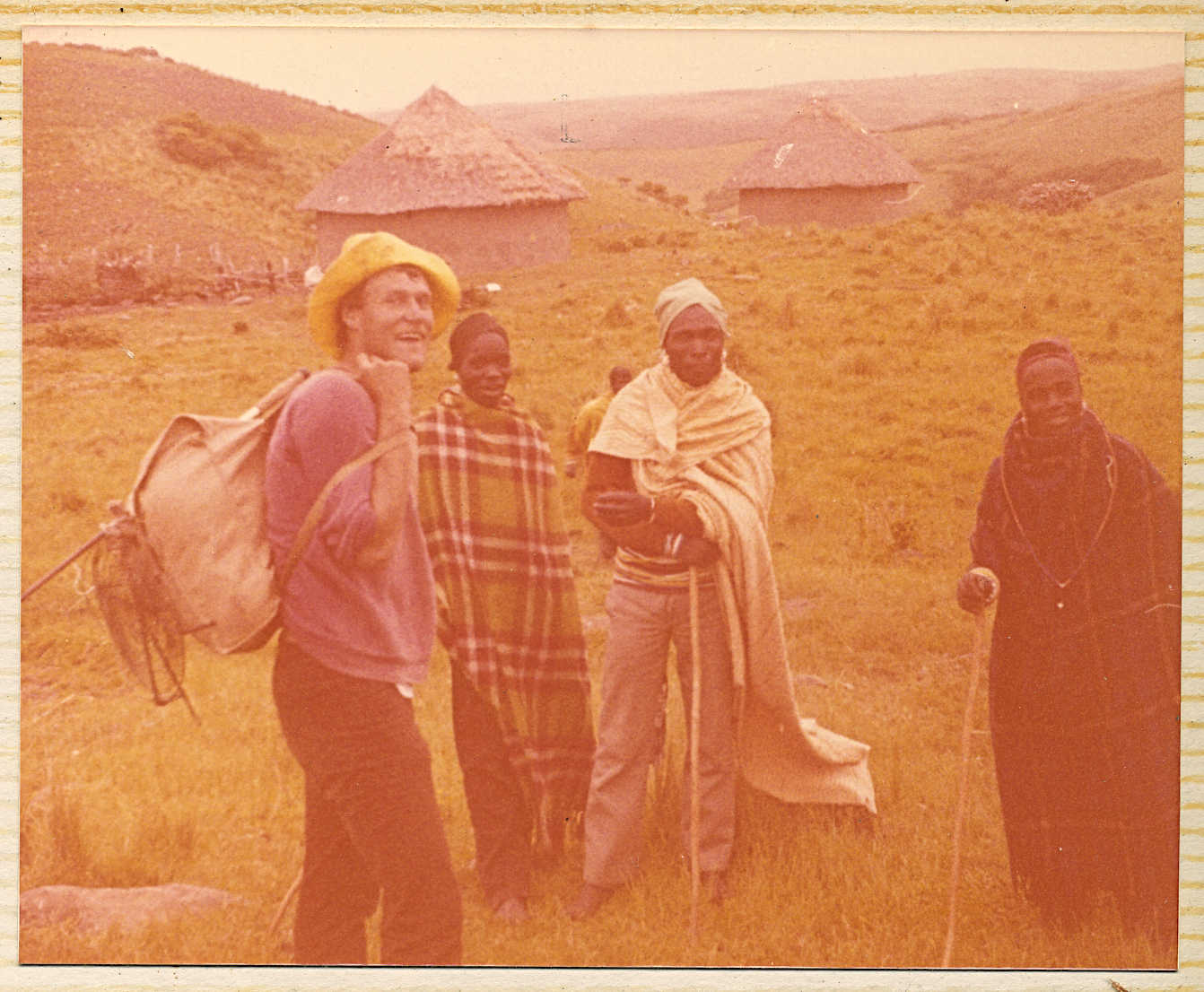
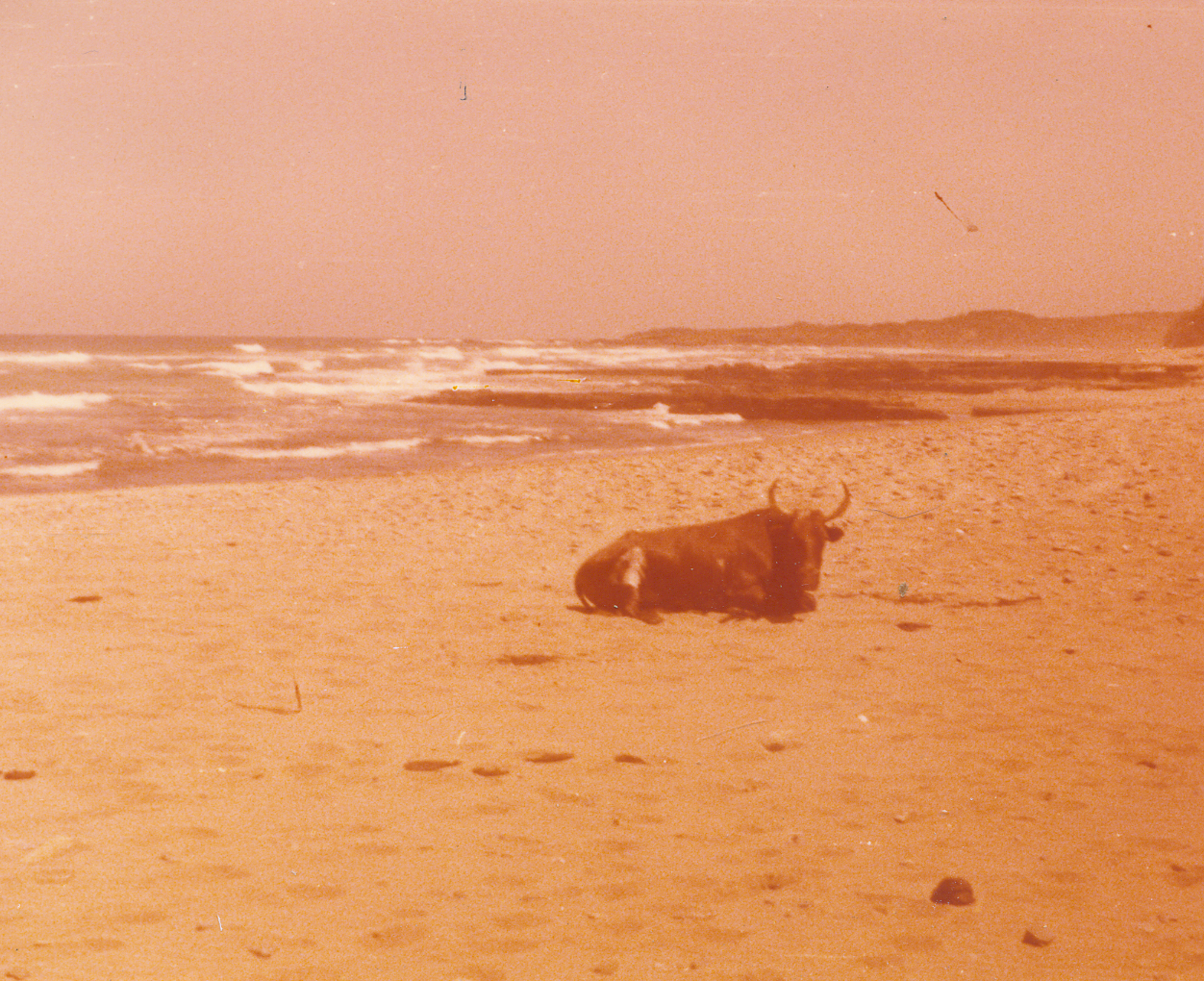
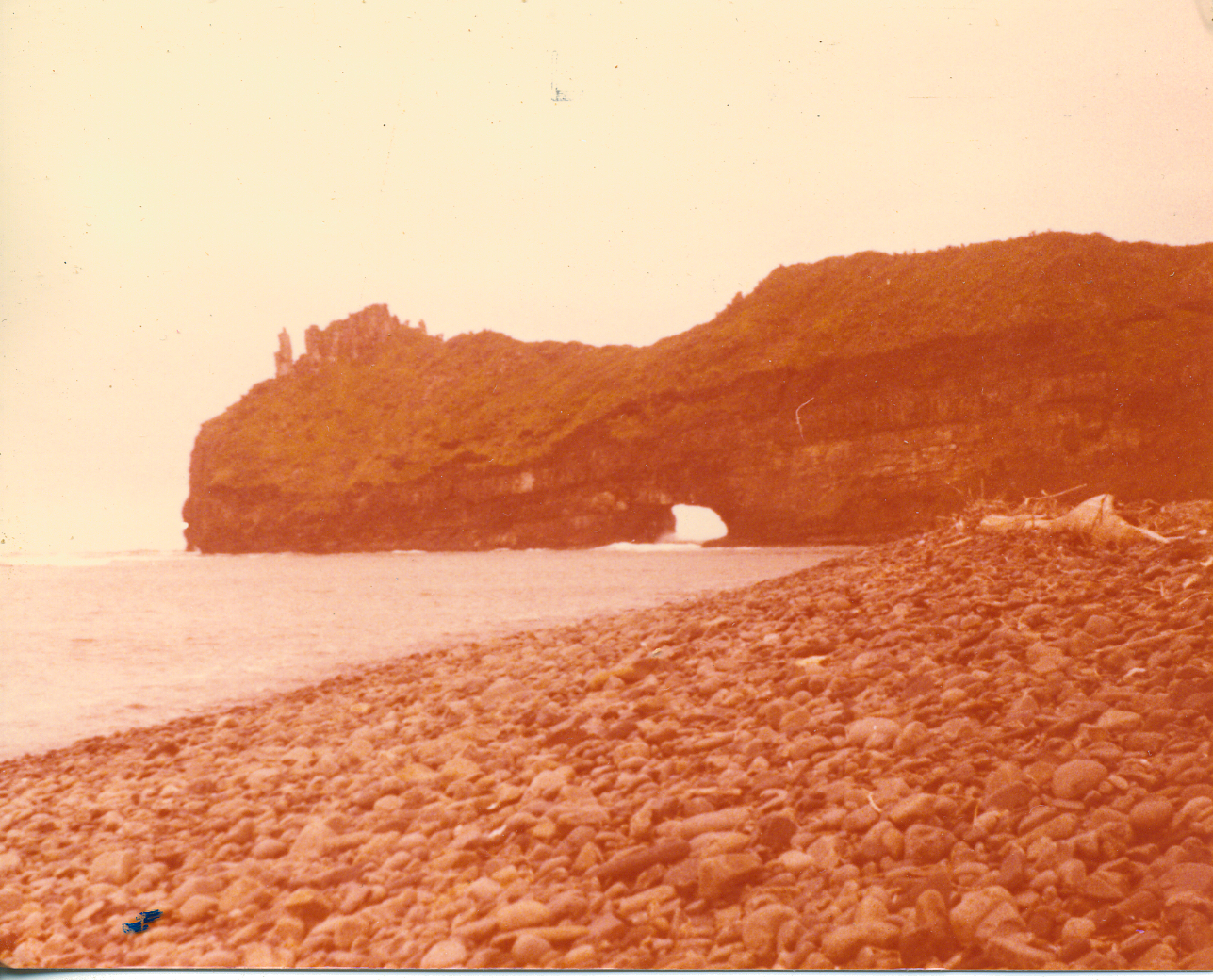
Long, long, loooong ago I planned a hike up the Wild Coast with friends. We spent ages planning the trip. I was going to be in Plettenburg Bay and three of them would come through to pick me up and we would drive through to the start of the hike at the Kei River Mouth. On the pick up day my friends arrived with four in the car, said “sorry” and drove off. So I walked up to the main road and hitchhiked up to the Eastern Cape.
Near East London I got a lift from a guy called Ian who was on his way to pick up his mate, “Rock Fist” to head down to Kei River mouth to hike up the Wild Coast. They were taking fishing rods to catch protein and were going to buy ‘samp and beans’ from the locals. I had a pack full of fresh veggies, some cans, oatmeal and dried fruit. And so we agreed to walk together. We parked at Trennerys Hotel and walked up the coast a little and found a campsite for the first night.
They had planned a four day hike, two days up and two days down or something. But somewhere on the first day we decided to head for Coffee Bay, about 100 kms North. Our stroll became a stiff walk. We would rise early and walk and stop for oatmeal porridge and dried fruit. We would snooze through the heat of the day and walk in the cool afternoon and find a place to cook a meal and camp.
Once we stopped to fish and I caught a nice Black Tail in a gully with my hand-line which we braaied.
What a beautiful route. A small adventure indeed. We got to coffee bay in good time. Instead of continuing up the coast I caught a lift back to the Eastern Cape with the two guys then headed back to Cape Town.
When we dropped Rock Fist at his farm, he gave me a bottle of honey that tasted like toffee. This came from a hive in a tree on the farm. He told me how bakkie was covered in honey from the harvest process. But the next day when they wanted to wash the bakkie the “little bees” had already cleaned away all the honey. I have never forgotten the appreciation in his voice when he told this story about “the little bees”. We sometimes have swarms settling in our garden. I contact Graham the local Bee-Guy to come and fetch “the little bees”.
Ian went on to become an icon in the South African movie industry, playing in an Oscar winning movie “Tsotsi”. He is best known perhaps for his role in a TV advert where the expression “Ja Boet” was fixed in South African folklore.
I read an article about Ian in a local angling magazine and thought to send this story to the editor. But didn’t.
Back in Cape Town I found a vacation job in Seapoint, serving tables in a high end restaurant. Dee, the chef used to race BMW motorcycles in Germany and he helped me buy my first motorcycle, a 1960 BMW R60. The start of a whole new story - for later...




Completing a MSc
I really did try my best at the studies and completed a degree in Geology and Chemistry. At the end of this time I was keen to extend my term and signed up for a Masters Degree in Applied Science. I completed a design project for our local Nuclear Power plant under another chap called Bob. And then completed a masters thesis on Abrasion in Agriculture – the wear of steel ripper blades. Another long and winding road.
During this time I had my first experience with Watercolour. I was sharing a flat with my sister Margie who was studying Architecture. One day I borrowed her watercolours and went down to Cape Point Reserve. I sat and painted two watercolours near the parking lot at Olifants Bos. I found the experience and little frustrating and the results less than satisfactory.
My supervisor leading me through a mini-thesis in preparation for a Masters in Applied Science once told me he was given a book of conversion factors and essential engineering equations for a birthday when he was a kid. I nodded approvingly but I remember thinking “that is the worst gift I can imagine”. This could have been an indicator that I was cut from different cloth I guess.


The Black Mamba Story

A blowout in Transkei
As we talked a small car towing a bike trailer passed us and pulled over. Hope soared. I walked up and explained our predicament. He said he was on his way to East London. But he said “I will never get through the Kei-Cuttings with two bikes, you guys and your gear in this little car”. Oogh! - My heart sank. Again!
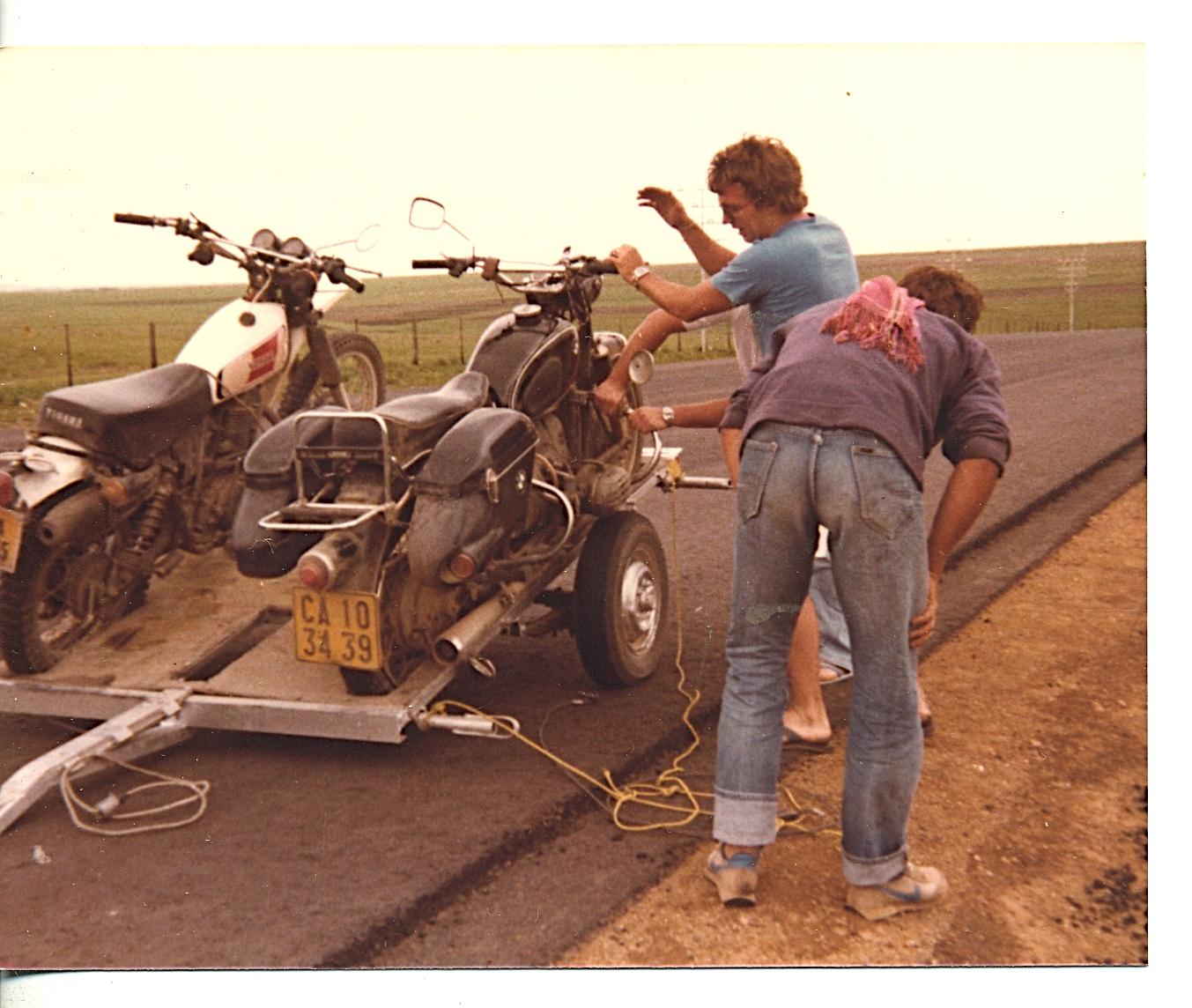
As a student I had blown my travel budget on a misdiagnosis on the way up to Johannesburg from Cape Town. A story with a different moral, for another time. We had just enough to make it to Cape Town.

Heading in to campus on return from the BM trip
When we got back to Cape Town I rode in to campus to take up the final work on my six week project that had taken a year. And therein lies a tale with few twists and turns.
I was in the final stages of drawings for a design project for Koeberg Nuclear Powerstation which at the time was under construction. The project was to created a test-kit for the bridge-bearings on which the nuclear island was placed as part of Earthquake protection. I had done the design under the supervision of Bob. This should be enough context.
Later in the year I arranged to take all of my design drawings in to ta printer in the city. One of the lab assistants agreed to ride pillion to hold the roll of drawings. I cruised out of campus and headed on the blue route towards. it was late morning and the traffic was not too busy but moving fast. As I took the on-ramp up onto the Settlers Way section of the N2 at the bottom of Hospital Hill l noticed a driver right on my tail. He was dangerously close. There was not much either of us could do as bus was coming up the N2 on just the other side of the merging lane.
But then, the driver behind me decided to over take me in the merging lane. He came sweeping past me close on the right. And as he cut in, in front of the bus his bumper clipped my front tyre. The force slewed and flipped the bike throwing both of us onto the road. It was all so fast. All I can remember was sliding up road on my butt with a bus wheel making a loud hum next to me. Then I stopped. The bus disappeared up the rhill. The driver disappeared. And my mototrbike disappeared. It was also gone! Just Reggie and I were left standing in the middle of the rushing traffic. drivers hooted at us as we tried to get to the side of the road. As I stood there in shock I could not figure out what had happened to my bike. Then I saw it lying upside down in the drainage ditch next to the highway.
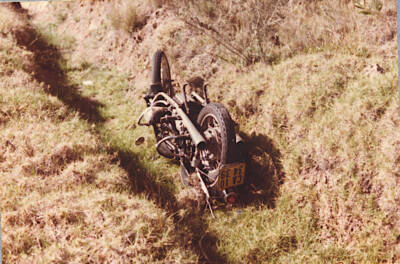
Instinctively I flagged down the passing traffic. I guess we looked weird standing next to the freeway where there was no pedestrian access. Eventually someone stopped. And then an ambulance showed up and pulled over. Reggie's forearm was badly grazed. While they bandaged him I went to look for my keys. I used to keep my keys on a cord in my back-pocket and as I skikked along the road had worn through the pocket and the cord and my keys were lying in the middle of the road as people accelerated around the curve to climb the hill. Aywway - somehow I managed to retrieve the keys. The driver who had passed me had also stopped and had made his way down to the scene. He was a driver for a car rental company.
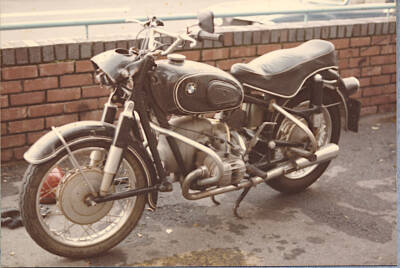
This is the only other image I have of my bike.
A group of guys helped me to lift the bike and set it on its wheels. Although the headlight was buckled I was able to engage the ignition and tried to kickstart the motor. And it started. Those sweeping crash bars had protected the pots from being torn off. The handlebars were wonky but the controls worked. I rode back to campus in the service area on the wrong side of the road.
I have told parts of this story at baais but this is the first time I have written it down.
And so it feels like the story needs a conclusion. Reggie was shaken and scraped but otherwise OK. The BM was far from written off. However I did not have the heart for another rebuild. Or the budget. Even then parts were hard to come by, and expensive. So I sold the BM to a guy in Cape Town who had a name for building old BMW motorcycles. And I remain thonkful to this day that God protected us in the midst of this event. And that is all I have to say about that.
Except that I made enough on the BMer to buy an XT500, months before motorcycle prices went through the roof.
Now I can see the hand of God in all of these things. And I have a long long list of many times in which I have been protected, sometimes through real danger. Though it would be years before I felt his calling.
2. Studying
This time eventually drew to a close and I packed my XT 500, said farewell to my mate Warren and his Girlfriend and hit the road to Swakopmund. Actually I had already accepted a job in Johannesburg when I was approached by the HR manager at Rössing Uranium who flew me up for an interview for a job for which I was utterly unqualified in so many ways.
The idea of working in Johannesburg was so depressing that I took the job in Swakop.
3. Moving to Swakopmund
I rode up on a route I had travelled many times before. I spent a night in Windhoek and a night in the desert on the route to Swakopmund. After 10 weeks working on the mine I flew down to Cape Town to marry Aura whom I had met in the Materials Engineering Department. And we made our way back to what was soon to become Namibia.
One Saturday afternoon Aura and I walked through the town when I was arrested by a wonderful watercolour in the window of a gallery. A fish-eagle doing a power-stroke with a fish in its talons. Each pinion feather captured by the single stroke of a broad-brush. I had never seen such a wonderful work. We went in and I was amazed at what I saw. It was a watercolour exhibition by a local artists; Nicholas Galloway. And he taught a watercolour class. I signed up and that Tuesday was introduced to a partner who has held me in a spell ever since.
After a while I chose to work on my own. Every now and then I would take my work to Nicholas for critique. He was always gracious. I would also take my work to Sharon and Don at the Hobby Horse, a craft shop and gallery in the town. Sharon was always so helpful, kind and direct. She also sold some of my work in the gallery. I decided that if ever I held an exhibition I would do it there.
The lady in the other gallery – the Guinee foul story
But it was not all plain-sailing. As part of the process I started painting watercolours of pelicans. These interesting birds are ungainly on the ground and breathtakingly beautiful in the air. I took my paintings to Isabel and she was graciously positive about my work. And then in a moment in which my tongue raced far ahead of my brain I said “Yes, I am planning to do a whole series about pelicans. You know, everyone is painting guinea fowl and it is so kitsch!” As the words floated across the space I caught, in my peripheral vision lots of dark blobs with white spots. A wall full of guinea fowl paintings. All painted by the woman standing in front of me. I picked up my work and left. Later I went in and said how desperately sorry I was. I still am not sure what that was.
Namibia was a wonderful place. I loved all of the excursions into the desert and up the coast. But I began to miss the green forests of Cape Town. My work at the mine had also reached a ceiling. By then I was writing code and designing databases and systems for the mine. So I looked around for another avenue.
Heading back to Cape Town
The Oil Industry
At the start of 1991 I returned to Cape Town to work in the Oil Industry. It was great to be back in the Cape. I walked on the mountain and enjoyed the Cape beaches. I would regularly walk up Lions Head before work and up the India Venster Route on Table Mountain after work.
I set aside watercolour for about a year. I told myself that I needed to focus on my career in Data. However that was not for long as my passion for the medium just broke through. I would pin my watercolours on the partitions in my cubicle. Through each day I would consider how to improve the work.
After six years I was enticed to join a Software Engineering team in one of the giant insurance companies. Just before I left someone left a note in my hokkie saying that I should have an exhibition. This story is covered in the blog post about Animus and Anima.
At the time it felt like my career and everything else had tanked. A friend showed me Julia Cameron’s book “The Aritists Way” and I would sit in my car in the parking lot each day and write my three pages. The process helped me emerge from a deep dark hole. I remember writing at the top of the page each morning, “what are you doing about an exhibition?” Just that. And in September that year I took 80 paintings to Swakopmund for my first ever exhibition. It was a life milestone.
Largely as a result of the same process I also shifted my focus from Software Engineering to team development and wroskshop facilitation. And at the end of the next year I joined a small consulting company facilitating project related workshops. It was intense.
During this time I also held an exhibition in our local nature reserve Helderberg Reserve., in the information centre.
The pressure in the consulting company was onerous and I left towards the end of my second year to offer the same services on my own. Ages unfolds
4. A watercolour a day
In the first month of 2013 I heard someone talking about how artists do not need to adopt the ‘starving artist’ motif. She spoke about how a local artist had set up a business model based on her work in doing “one watercolour a day”. Well that was the part I heard. And so I started, that day, somewhere in mid January. I went down to The Pipe and did my first “Watercolour of The Day”. I maintained this cadence for just over five years in spite of an onerous consulting schedule. For the first three or four years I posted religiously on Instagram. What I missed however was the rest of the business model. But I certainly improved my skills in watercolour.
I remember flying in to Gaborone, meeting my client for the workshop I was to facilitate the next morning, preparing my materials and collapsing into bed just after midnight. Only to remember “watercolour!”! Getting up and doing a 6 minutes sketch of a strawberry from a fruit bowl left in my room. And the next night, in the midnight hour, painting a plumb. These two delightful little watercolours remain among my favourite pieces.
How does this reason to paint in watercolour resonate for you?
Up until 2019 I was a consultant who spent an inordinate amount of time and energy painting in watercolour. But in 2020 I shifted the balance to go for the gold (the Indiana Jones reference (o: ).
The consequent spiders, thrutching* and rolling boulders have set a statement of purpose for this. But this statement omits one core value in all I do.
A part of me wants just a little adventure.
But my deeply ingrained limiting belief was that only other people got to go to the interesting places. Ja irrational hey? I had some great outings with friends. The picture shows a walk up Ledges with a group. But found myself outside of the group who invited each other on trips.
Eventually I decided to get out on my own. At first, instead of driving to my digs in Fishhoek after a late night on campus I would spend the night in Newland forest, returning to campus in the morning. On Fridays I would sometimes work in the Geo Lab till 15:00 and then hike up Newlands Ravine, The Knife Edge and Ledges Route to spend the night at the entrance to Carrels Ledge on Table Mountain
(https://capetownscrambling.wordpress.com/2018/01/25/ledges/).
I well remember looking over the darkening Cape Flats from the top of mountain, drinking milo tasting of hand cream because those were the best bottles I could find to stop the condensed milk from seeping out into my kit.
These small adventures (and misadventures) were most satisfying. And scary. Going off-route on the Fir Tree section once led up a very tricky face, in the gathering dark, with all my camping gear on my back.
This remains a significant value for me, and a component in why I paint in watercolour. In 2002 my watercolour exhibition in the information centre at Helderberg Reserve was called “Small Adventures”.
I have just updated my “Artist Statement” on https://sjqwatercolour.com/ to reflect this idea.
*Thrutching: A climbing term - a synthesis of thrashing and clutching. If you have been there – you will understand.


The Plan of the Story
In 2019
In 2019 The Friends of Radloff Park
The Global House Arrest
5. From Calendar to Collection – From Hobbyist to Professional
Radloff Park – Two one-night exhibitions
The Global House Arrest
Patch HCA and the Basin Paintings -
Lourens River
False Bay
Lanzerac
How to maintain an income while I build a name as a watercolourist?
6. What the Future holds
George Collection
Lanzerac collection update
West Coast collection
More Lourens River Paintings
Output – end Part
I am writing this story to draw people into the context of my art. Rather than a string of boring events I want each component to describe an obstacle, what I did about it and how it shaped me as an artist.
Curriculum Vitae
Hobby Horse
WCWS
Animus and Anima
Helderberg Reserve
The Sculptors
SASA Winner – 2023
WCAS Winner 2023 and previous
Lanzerac 1
Lanzerac 2